You send a brief to a sample provider. Can you fill 400 completes, US consumers who bought a major appliance in the last 12 months? A day later you get the answer: "Yes, feasible. CPI $6.50."
That is the entire feasibility check for most studies. A number and a price, in an email. You commit budget and a timeline on it, your client commits a deadline on it, and you find out whether it was true somewhere around day four of fieldwork, when the completes slow down and the replacement conversations start.
We just released something built to replace that email: the quote. This post explains what it shows you, and why we think a feasibility answer should be verifiable before you accept it, not after.
Feasibility today is a claim, not an answer
When a provider says "yes, feasible," here is what usually sits behind it: a panel book of checkbox demographics, an incidence assumption someone typed in, and the knowledge that if the panel falls short, they can route traffic in from external sources you will never see.
None of that is visible to you. You can't check who the respondents would be, you can't check the math behind the number, and you can't tell whether "feasible" means "we have these people" or "we'll find them somehow."
The industry-wide result is well known: termination rates of 60 to 70% are normal, because the standard model sends traffic into your screener first and sorts it out after. Two of three respondents get cut mid-survey. That waste was already priced into the feasibility answer you got. It just wasn't disclosed.
What we released: the quote
Enlightn works differently: we only recontact panelists we already know, profiled with open-ended questions and quality-checked before they ever enter the pool. Never anonymous traffic. Since we know who is in the pool, we can show you the feasibility work instead of asserting it.
The quote is that work, as an interactive page. You send a brief, and within 24 hours you get a link (password-gated, so your pricing and panelist details are not sitting behind a guessable URL). It is generated directly from our matching engine's output, and it is free: the quote is how we answer feasibility, not something you pay for.
Here is what's inside.
A confident floor, with the math shown
For each target, the quote commits to a floor: the number of completes we are confident in, not a hopeful point estimate. In the example below, the buyer asked for 100 completes and the quote commits to 95, and says plainly that it is 5 short. Fieldwork often delivers more than the floor; we just refuse to promise a number we are not confident in.
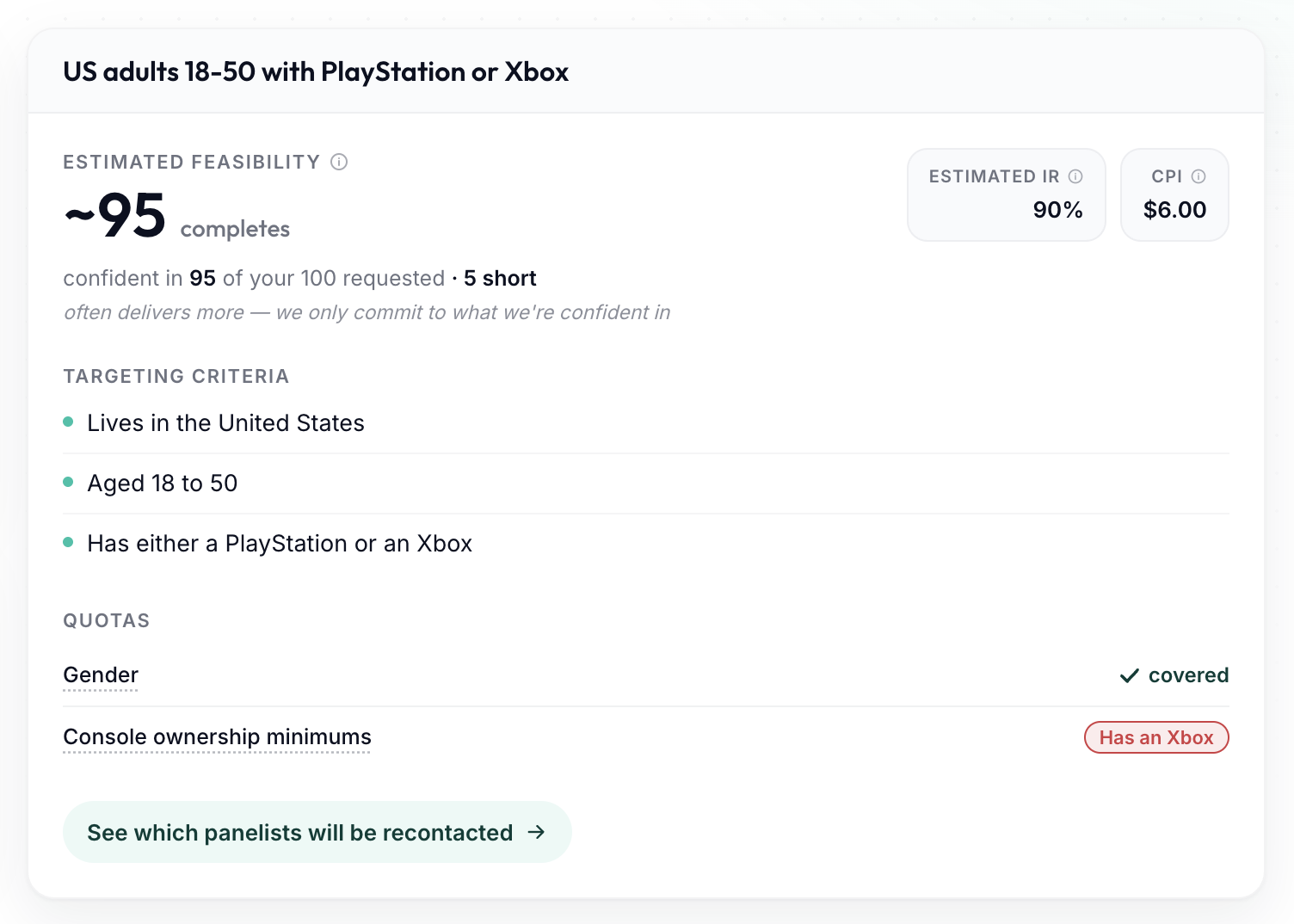
Hover any number and you see exactly how it was computed: how many profiled panelists matched your criteria, the recontact rate we apply, the incidence assumption we used.
Incidence, if the term is new to you, is the share of respondents who actually qualify for your study once they start it. It is the assumption most feasibility answers quietly get wrong. In the quote it is stated, per target, where you can challenge it.
If real fieldwork comes in different from those assumptions, the re-quote bands are stated upfront too. No number in the document exists without its calculation attached.
The pricing follows the same logic: a per-target breakdown, the blended CPI (cost per interview, the per-complete price), and the estimated total. You are billed per delivered complete. If we commit to a floor and miss it, that's our problem, not a line on your invoice.
The panelists behind the number
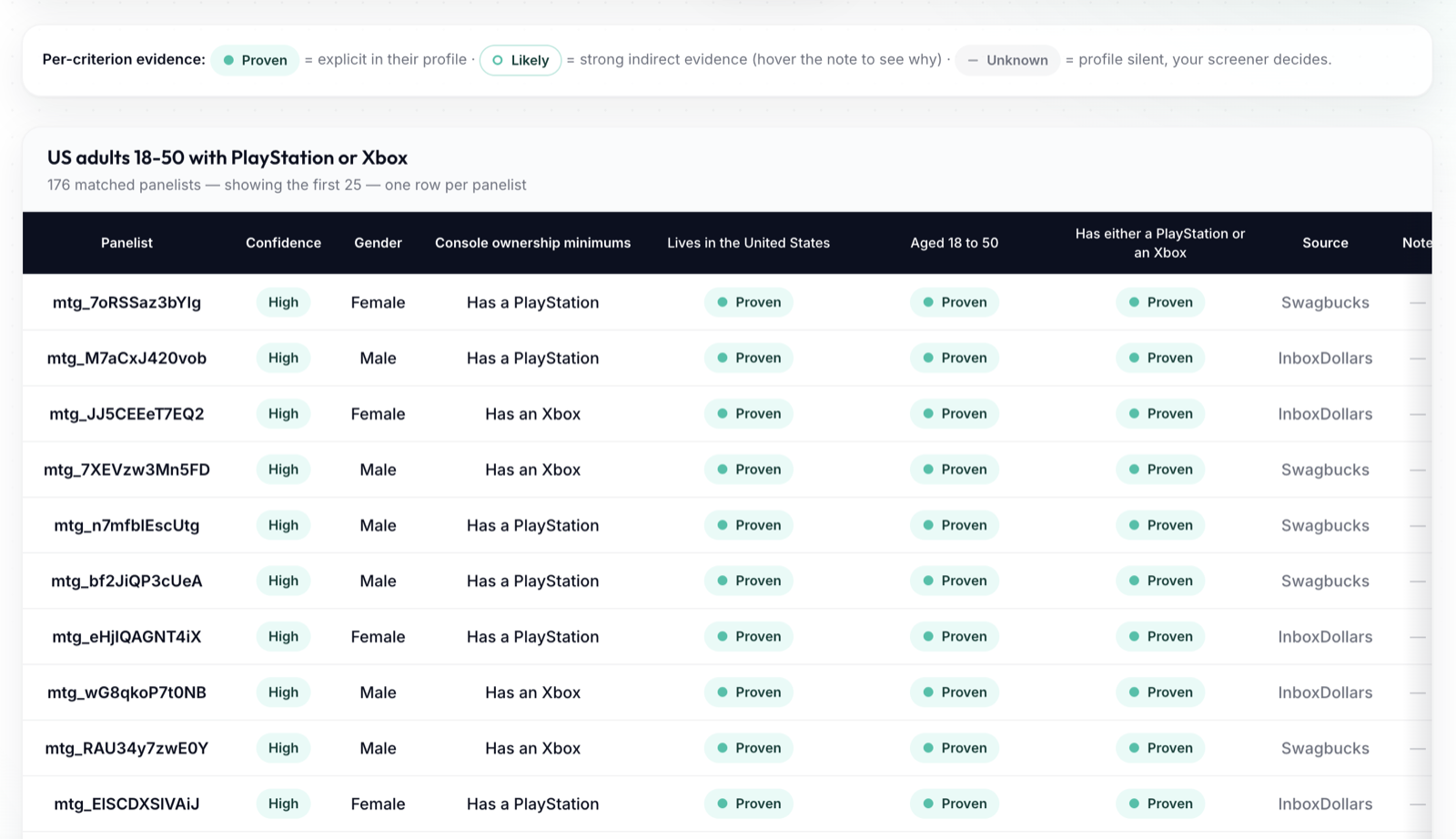
This is the part no email can carry. The quote has a second tab listing the matched panelists themselves: for each one, the evidence per criterion in your spec, the source they come from, and the engine's reasoning where a match was inferred rather than stated.
The evidence comes in three honest levels. Proven means the criterion is explicit in their profile. Likely means strong indirect evidence, with the reasoning shown on hover. Unknown means the profile is silent on that criterion, and your screener decides. We could have collapsed all of that into a single match score. We didn't, because a buyer defending a sample to their own client needs to know which claims rest on what.
The quote also spells out how a panelist got into the vetted pool in the first place: recruited from a source we quality-tested ourselves, fraud-cleared through our detection provider, profiled through a conversational questionnaire built mostly on open-ended questions, behaviorally vetted by AI review, and only then matched to your study.
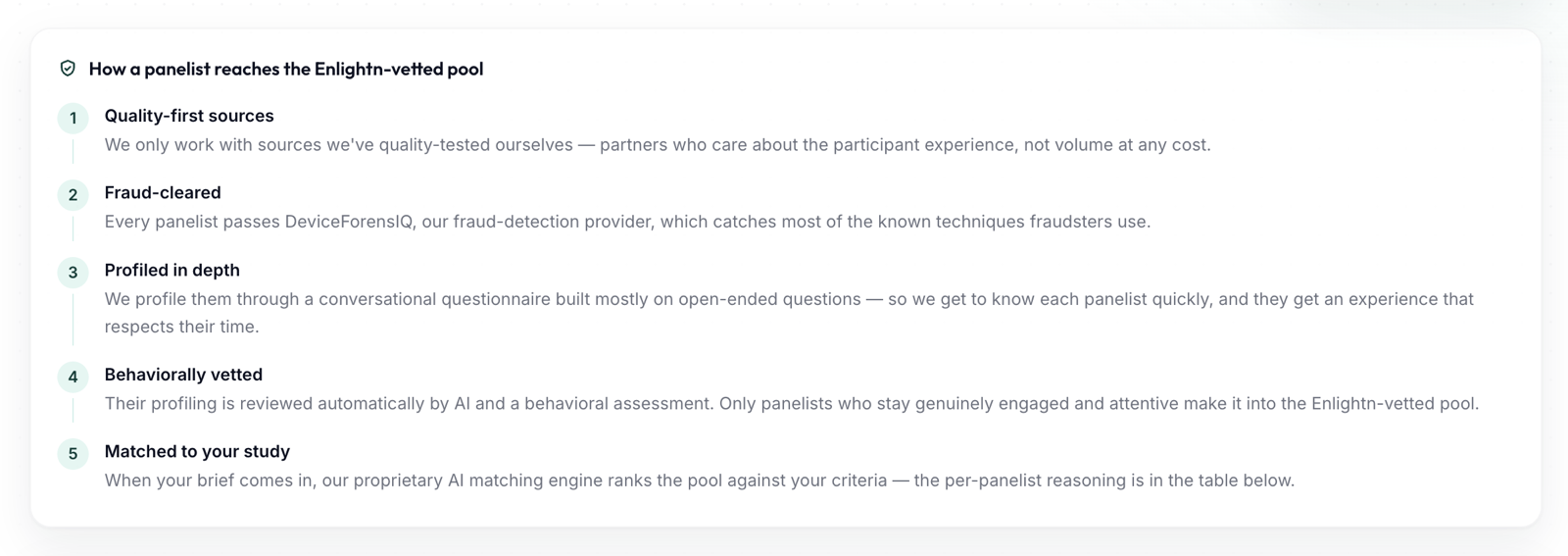
The point is simple: you can verify that the feasibility answer is built on people we already know, matched to your study before any invitation goes out. Not on traffic that will be found once you sign.
When we can't cover the full ask, you see that too
Sometimes the vetted pool covers your full request. Sometimes it doesn't, and this is where most providers blend in external traffic without telling you.
When we are short, the quote says so, and gives you the choice: Enlightn-vetted only (the default), or full coverage, where the gap is filled from external partner sources, priced at cost plus a flat, disclosed markup, and shown as a separate line. Never mixed into the vetted pool. And if a complete does not come from our vetted pool, you see it in the quote, in the delivered data, and in the fieldwork analysis after.
We think the honest version of this trade-off belongs on the quote, decided by you, not handled quietly on the supplier side. Nothing is blended without you seeing it.
Why we built it this way
Every sample provider claims quality. You have heard it enough times that the claim carries no information anymore, and you have no way to compare one claim against another. So the market defaults to the one variable that can be compared: price.
Our answer is to stop asking you to believe anything. The quote shows the work before fieldwork; a fieldwork analysis shows the outcomes after (incidence, disqualification, completion, drop-off, actual versus what the quote committed). Between the two, the quality question becomes checkable.
The early evidence is on the quote's side. Across pilot projects with our first paying client, recontacting known, matched panelists produced a 2.1× good-to-bad quality ratio versus benchmark supplier traffic on the same studies, and a 43% lower disqualification rate on identical screener logic. One client, observational pilot data rather than a randomized trial, and larger-sample validation is ongoing through 2026. But the direction is consistent across studies, and every buyer we work with gets their own numbers in their own fieldwork analysis.
How to get one
Send us a brief: a screener, a quota spec, or just the targeting written in plain English. Within 24 hours you get your quote, free, with no commitment attached. Worst case, you learn exactly how feasible your study is and what the math looks like. Best case, you never accept a one-line feasibility answer again.
Enlightn is a sample provider that only recontacts panelists it already knows — profiled, quality-checked, and matched to your study. Never anonymous traffic.
If you're running fieldwork and want to see your own study in a quote, and we'll return your quote within 24 hours: who we'd recontact, expected incidence, and why they qualify — before you commit a dollar of sample budget.