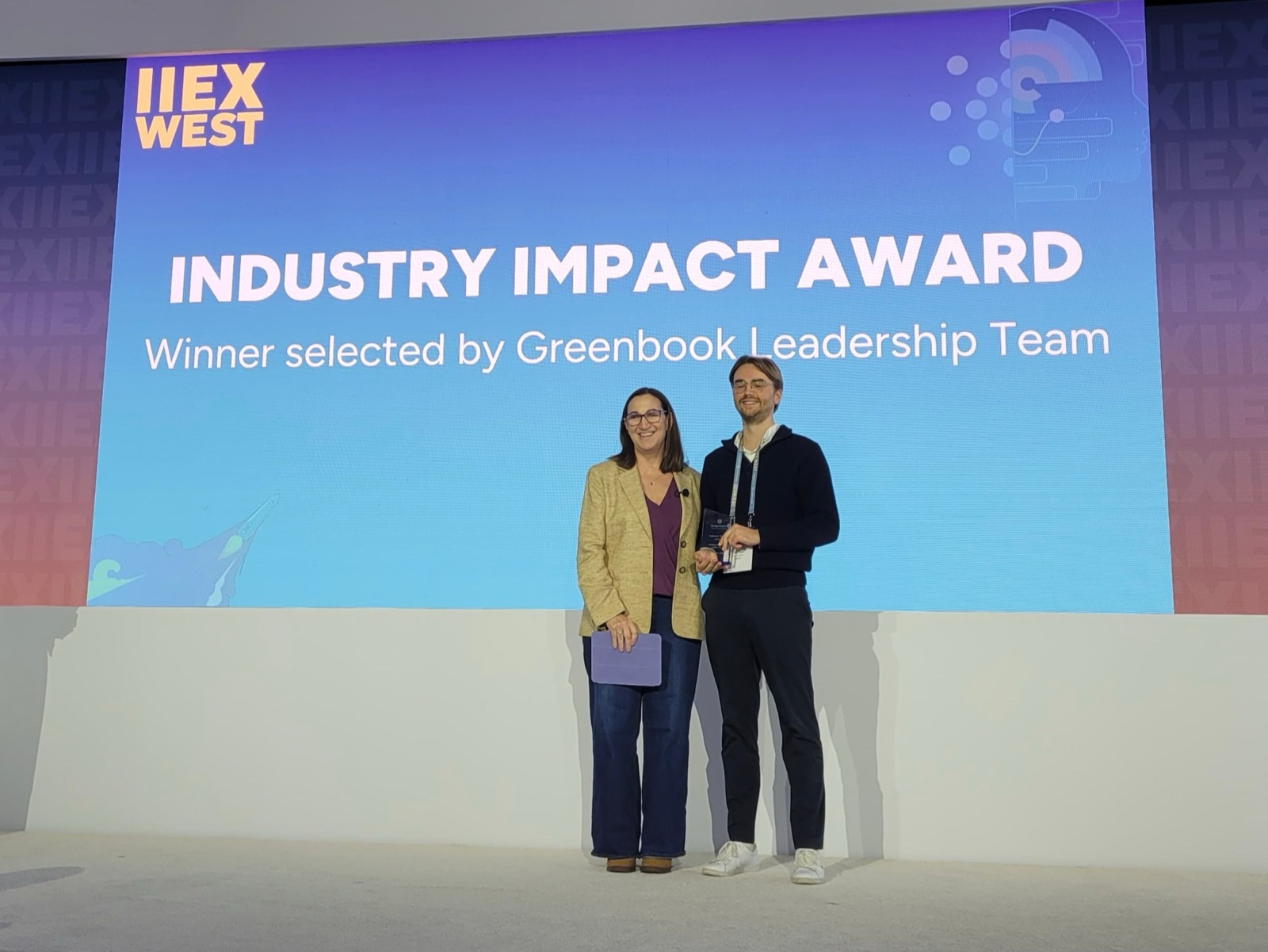
On October 28, Enlightn won the Industry Impact Award at Greenbook's Insight Innovation Competition, at IIEX West in San Francisco. The award is selected by the Greenbook leadership team.
“The Industry Impact Award recognizes the finalist we believe can make the biggest real-world difference for our industry. As AI reshapes market research, knowing who is behind the data matters more than ever, and Enlightn is tackling that question at its root.”
Karen Lynch, Chief Programming Officer, Greenbook
This article explains the problem we're working on, what we've built so far, and where we're going next.
A respondent experience that pushes the best people away
Survey research runs on people willing to share their opinion. Yet for a typical panelist, the experience looks like this: click on an invitation, spend a few minutes answering screening questions, then learn you don't qualify. No pay, no explanation. For many panelists, that's two invitations out of three. And when they do qualify, the reward often works out to about $2.50 an hour.
This isn't bad intent from anyone. It's how the system is built. Too often, suppliers push traffic to a survey hoping it qualifies, instead of investing in knowing their panelists well and showing each person only the studies that fit them. The screener does the sorting, and the respondent pays for it with their time.
Part of the reason is structural: the same company vouches for its respondents and sells them. Suppliers are paid per complete, so the game is volume, and buyers have very little visibility on who actually answered. In that setup, improving quality is mostly a cost: removing panelists who still complete, paying for fraud tools, adding operations work.
Fraud makes it worse. Bots, duplicate accounts and people misrepresenting themselves to get past screeners push buyers to add more traps, longer screeners and heavier cleaning. Honest respondents go through all of it too, and some get removed by mistake. The experience gets worse for the people we most want to keep, and trust in survey data erodes a little more each year.
Why this can't last
For a long time, respondents didn't have many alternatives. That's changing. AI training tasks now recruit the same kind of people, often pay more per hour, and arguably offer a better experience: no screen-outs, clear instructions, paid for the time spent. We don't have hard data yet on how many respondents are moving, but the direction is clear.
If the best respondents leave, everyone loses. Buyers get data they trust less, suppliers lose their most valuable panelists, and the one thing survey research has that synthetic data doesn't, real people's opinions, gets weaker. Our industry needs to address these structural challenges and restore the trust that eroded over the past years. Knowing who is behind the data is where it starts.
Three questions every survey response should come with
For each person who answers a survey, buyers and suppliers should be able to know three things.
1. Is this a unique human, answering from the intended country?
Today this is mostly checked at the door, with IP geolocation and duplicate detection. These checks are useful, but residential proxies and VPNs get past them, and the same person can sit on several panels under different accounts.
2. Can we trust their answers?
Today trust is judged inside one survey: attention checks, open-end review, cleaning after fieldwork. For the buyer, each study starts from zero. A respondent who gave careless answers last month can show up again tomorrow, and a consistently thoughtful one gets no credit for it.
3. Is this the right person for this specific study?
Today the screener answers this, after the invitation. That's why two people out of three are invited for nothing, and why the system rewards people who learn what to answer to get in.
And who answers these questions today? Mostly the supplier, the same company that is paid for each complete. Many suppliers work hard on quality. But a buyer can't verify any of it, and that's the gap we want to close.
What we've built so far
Enlightn doesn't own panelists. We work with trusted suppliers to profile their own panelists, and we use what we learn to answer the three questions before anyone is invited.
Panelists start with a profiling questionnaire built on open questions, answered in their own words, which we turn into dozens of facts we can target on. Every survey they go through afterwards, qualified or not, adds to their profile. Over time, we also look at how they behave: fraud signals, in-survey behavior, whether their answers stay consistent from one month to the next.
When a buyer sends a brief, we score every profiled panelist against it and only invite strong matches, through the supplier's own recontact tools. Before fieldwork, the buyer receives a quote with the feasibility, the price and the evidence behind each match. Nobody is pushed into a screener hoping to qualify, so nobody needs to misrepresent themselves to get in.
Across the studies we've delivered for our paying clients, on the same screeners and against benchmark supplier traffic, Enlightn respondents showed a good-to-bad quality ratio 2.1 times higher and a disqualification rate 43% lower.
These are averages across a limited number of client studies, not an industry-wide benchmark. We share per-project results openly with each client.
Where we're going
Today, we deliver sample ourselves. That's how we built and tested this approach. But selling sample puts us in the same position we described above: paid for each complete. And it limits us to the studies we field ourselves.
The next step is to move out of the supply chain and become the neutral third party the industry is missing: a longitudinal record of each respondent, built with their consent, whatever panel they come from. Not paid per complete, so with no reason to favor volume over quality.
Suppliers use it to invite the right people, and get credit for sending real, engaged ones. Buyers use it to trust what they get back. A credit bureau, but for respondents.
That's the work this award recognizes, and it's only the beginning. Thank you to the whole Greenbook leadership team for the recognition.
Whether you buy or supply sample, talk to us about who is really behind your data.
If you're running fieldwork, and we'll return your quote within 24 hours: who we'd recontact, expected incidence, and why they qualify. If you supply sample, here is how partnering with us works.